Embark on a celestial journey! This guide illuminates the wonders above, offering a season-by-season exploration and interactive activities for all ages.
Why Stargazing is a Wonderful Family Activity
Stargazing fosters connection and creates lasting memories. It’s a unique opportunity to disconnect from screens and reconnect with each other under the vast, awe-inspiring night sky. Sharing the experience of discovering constellations and planets sparks curiosity and encourages collaborative learning.
This activity transcends generations, allowing grandparents to share stories and knowledge with grandchildren. The included star charts and pull-out activities, like the “What do you weigh on other planets?” wheel, enhance engagement and make learning fun. It’s a chance to build a shared passion for astronomy and the universe around us, fostering a sense of wonder and exploration within the family unit.
Benefits of Connecting with the Night Sky
Observing the night sky cultivates a sense of perspective and humility. It reminds us of our place in the cosmos, fostering appreciation for the universe’s immense scale and beauty; Stargazing encourages scientific thinking, prompting questions about the stars, planets, and galaxies.
Understanding Basic Astronomy
Delve into the science of the stars! Learn about celestial objects, distances measured in light-years, and the fundamental principles governing our universe’s vastness.
What is Astronomy?
Astronomy is the captivating study of everything beyond Earth’s atmosphere. It encompasses the observation and explanation of celestial objects – stars, planets, galaxies, nebulae – and the physical laws that govern them. This ancient science seeks to understand the universe’s origin, evolution, and ultimate fate.
Essentially, astronomy is about unraveling the mysteries of the cosmos and our place within it.
Stars, Planets, and Constellations: Definitions
Stars are massive, luminous spheres of plasma held together by their own gravity, emitting light and heat – distant suns! Planets are celestial bodies orbiting stars, not producing light themselves, like Earth circling our Sun. Constellations are recognizable patterns formed by stars as viewed from Earth, often named after mythological figures.
These definitions form the foundation for astronomical understanding.
Light Years and Astronomical Units: Measuring Distance
The universe is vast, demanding unique units to measure its distances. An Astronomical Unit (AU) is the average distance between Earth and the Sun – about 93 million miles – useful for distances within our solar system. However, stars are much further away!
These units provide perspective on cosmic distances.
Seasonal Stargazing Guide
Discover celestial treasures year-round! This guide unveils constellations and events unique to each season, enhancing your family’s stargazing adventures.
Spring Constellations and Events
As winter fades, spring unveils a fresh perspective on the night sky. Look for Leo, the Lion, prominently displayed, and Virgo, often depicted as a woman holding wheat. Bootes follows the arc of the Big Dipper, leading to the bright star Arcturus.
Spring also brings meteor showers! The Lyrids, peaking in April, offer a delightful display. Observe the rising full moons and enjoy longer evenings perfect for exploring constellations with binoculars or a telescope. This season is ideal for introducing young stargazers to easily identifiable patterns and brighter celestial objects.
Summer Constellations and Events
Summer nights offer warm temperatures and a dazzling display of stars! The Summer Triangle – Vega, Deneb, and Altair – dominates the evening sky. Explore Scorpius, the Scorpion, and Sagittarius, the Archer, near the Milky Way’s brightest section. Cygnus, the Swan, gracefully crosses the overhead expanse.
Don’t miss the Perseid meteor shower in August! It’s renowned for its frequent and brilliant meteors. Summer’s longer daylight hours mean shorter stargazing windows, so plan accordingly. Utilize star charts and apps to locate these stunning constellations and enjoy the celestial spectacle.
Autumn Constellations and Events
As summer fades, autumn unveils a new set of celestial treasures! Look for Pegasus, the winged horse, rising in the east, and Andromeda, a spiral galaxy visible to the naked eye. The Great Square of Pegasus is a prominent landmark. Cepheus and Cassiopeia, regal figures, grace the northern sky.
October brings the Orionid meteor shower, a smaller but reliable display. Autumn evenings offer comfortable temperatures for extended stargazing. Utilize a double-sided star chart to navigate the changing constellations and discover the beauty of the fall night sky with your family.
Winter Constellations and Events
Winter’s crisp, clear nights offer spectacular views! Orion, the hunter, dominates the southern sky, easily recognized by its three bright belt stars. Look for the reddish glow of Mars nearby. Taurus, with the brilliant star Aldebaran, and Gemini, the twins, are also prominent winter constellations.
December features the Geminid meteor shower, often producing a high number of meteors. Bundle up warmly and enjoy the celestial display! A star chart will help you locate these constellations and appreciate the winter night sky’s beauty with your family.

Essential Tools for Stargazing
Enhance your stargazing experience! From telescopes and binoculars to star charts and helpful apps, discover tools to unlock the universe’s secrets.
Telescopes: A Beginner’s Guide
Choosing your first telescope can be exciting! Reflectors use mirrors to gather light, offering larger apertures for brighter images at a lower cost, ideal for faint deep-sky objects. Refractors utilize lenses, providing sharp, high-contrast views, excellent for planetary observation.
Consider aperture – the larger, the more light gathered. Mounts are crucial; altazimuth are simpler for beginners, while equatorial track celestial movement. Don’t forget eyepieces, determining magnification. Start with lower magnification for wider fields of view, gradually increasing as your skills develop. Remember patience and practice are key to mastering telescope use!
Binoculars for Stargazing
Binoculars are a fantastic entry point to stargazing! They’re portable, easy to use, and offer wide-field views, perfect for scanning constellations and locating brighter objects. Look for binoculars with a large objective lens diameter (50mm or greater) to gather more light.
Magnification between 7x and 10x is ideal for stability. Coated lenses enhance brightness and contrast. A sturdy tripod is highly recommended for comfortable, shake-free viewing, especially at higher magnifications. Binoculars excel at observing the Moon, star clusters, and even some nebulae, providing a rewarding experience for beginners.
Star Charts and Apps
Navigating the night sky is easier than ever with modern tools! Traditional star charts, often included in introductory astronomy books, provide a map of constellations and celestial objects. However, smartphone apps offer dynamic, interactive experiences.
Apps like SkyView Lite or Star Walk 2 use your phone’s sensors to identify stars and planets in real-time. Many apps also feature augmented reality, overlaying constellation lines onto your view of the sky. These resources are invaluable for learning constellations and locating specific objects, enhancing your stargazing adventures.

Navigating the Night Sky
Unlock the cosmos! Learn to pinpoint constellations, track planets, and understand celestial coordinates for a rewarding stargazing experience with your family.
Identifying Constellations
Begin your cosmic quest by learning to recognize patterns! Constellations are groups of stars forming recognizable shapes, often rooted in mythology. Utilize star charts – both traditional paper versions and interactive apps – to locate prominent constellations like Ursa Major (the Big Bear) and Orion the Hunter.
Start with brighter, easily identifiable constellations and gradually work towards more subtle ones. Remember that the night sky changes with the seasons, so different constellations will be visible at different times of the year. Creating stories around the constellations can make learning fun and memorable for the whole family, fostering a deeper connection with the night sky.
Locating Planets
Unlike twinkling stars, planets generally appear as steady points of light. Use a star chart or astronomy app to pinpoint their current positions. Planets orbit the Sun and appear to wander across the sky over time, so their locations change nightly. Venus and Mars are often among the brightest celestial objects visible to the naked eye.
Look for them near the horizon shortly after sunset or before sunrise. Jupiter and Saturn are also visible, though typically less brilliant. Remember that identifying planets requires patience and a clear view of the sky, free from light pollution. Observing them regularly will reveal their movements!
Understanding Celestial Coordinates
Just as Earth uses latitude and longitude, astronomers employ celestial coordinates to pinpoint objects in the sky. The celestial sphere is an imaginary globe surrounding Earth, upon which stars and planets appear projected. Right Ascension (RA) is equivalent to longitude, measured in hours, minutes, and seconds. Declination (Dec) corresponds to latitude, measured in degrees north or south of the celestial equator.
These coordinates allow astronomers to precisely locate and track celestial bodies. While complex for beginners, understanding this system provides a framework for navigating the vastness of space and utilizing star charts effectively.

Fun Activities for Families
Ignite imaginations! Create constellation stories, embark on a stargazing scavenger hunt, and discover “What Do You Weigh on Other Planets?” with fun tools.
Creating Your Own Constellation Stories
Unleash your family’s creativity! Looking at the patterns of stars, imagine the figures and characters they represent. Ancient cultures wove captivating myths around constellations, explaining the world and their place within it. Now, it’s your turn!
Choose a constellation, or even a random grouping of stars, and collaboratively invent a story. What adventures do these celestial beings embark upon? Are they heroes, villains, or mischievous tricksters? Encourage everyone to contribute ideas, building a narrative together.
Don’t be afraid to be silly and imaginative! Document your story with drawings or written tales, preserving your unique family constellation legend for years to come. This activity fosters storytelling skills and a deeper connection to the night sky.
Stargazing Scavenger Hunt
Transform stargazing into an exciting adventure! Create a list of celestial objects for your family to find – a specific constellation (like Orion), a bright planet (Venus or Mars), or even a shooting star. Adjust the difficulty based on age and experience.
Provide clues or riddles to guide the search, making it more engaging. For younger children, focus on easily identifiable constellations. Older kids can tackle more challenging objects and learn to use star charts or apps.
Award small prizes for each discovery, fostering a sense of accomplishment. This scavenger hunt encourages observation skills, teamwork, and a playful approach to learning about the cosmos!
“What Do You Weigh on Other Planets?” Activity
Explore the effects of gravity! This fun activity demonstrates how your weight changes depending on a planet’s mass and size. Using a simple chart (easily found online or included in stargazing kits), calculate your weight on Mercury, Venus, Mars, Jupiter, and Saturn.
Discuss why gravity differs on each planet – larger planets have stronger gravitational pulls. A spinning wheel, often included in stargazing resources, can make this interactive and visually appealing for children.
This activity connects astronomical concepts to everyday experiences, making learning about the solar system more tangible and memorable for the whole family.
Deep-Sky Objects to Explore
Venture beyond stars! Discover breathtaking nebulae, distant galaxies, and sparkling star clusters – cosmic wonders revealed through telescopes and binoculars.
Nebulae: Clouds of Gas and Dust
Imagine vast, colorful clouds floating in space! Nebulae are stellar nurseries where new stars are born, or remnants of dying stars – truly spectacular sights. These cosmic clouds are composed of gas (primarily hydrogen and helium) and dust particles, illuminated by the stars within or nearby.
Different types of nebulae exist, each with unique characteristics. Emission nebulae glow with their own light, while reflection nebulae reflect the light of nearby stars. Dark nebulae block light, appearing as silhouettes against brighter backgrounds. Observing nebulae requires darker skies and often, the aid of a telescope or binoculars to fully appreciate their ethereal beauty. They are a cornerstone of deep-sky exploration!
Galaxies: Islands of Stars
Venture beyond our Milky Way to explore galaxies! These immense systems are vast collections of stars, gas, dust, and dark matter, held together by gravity. Galaxies come in various shapes: spiral, elliptical, and irregular. Our own galaxy, the Milky Way, is a spiral galaxy, appearing as a hazy band across the night sky.
Observing galaxies, even with a telescope, can be challenging due to their immense distances. However, brighter galaxies like Andromeda are visible as faint, fuzzy patches. Studying galaxies helps astronomers understand the universe’s structure and evolution. They represent the largest building blocks of the cosmos, offering breathtaking views and endless wonder.
Star Clusters: Groups of Stars
Discover stellar neighborhoods – star clusters! These groups of stars are born from the same molecular cloud and share a common age and composition. There are two main types: open clusters, which are loosely bound and contain fewer stars, and globular clusters, densely packed spheres containing hundreds of thousands of stars.
Open clusters, like the Pleiades, are beautiful sights through binoculars. Globular clusters, found in the halo of our galaxy, require a telescope for detailed viewing. Observing star clusters provides insights into stellar evolution and the dynamics of galactic structures, offering stunning visual displays for stargazers.
Safety and Preparation
Protect your eyes and plan ahead! Minimize light pollution, dress warmly, and gather essential supplies for a comfortable and safe stargazing experience.
Protecting Your Eyes
Directly viewing the sun is extremely dangerous and can cause permanent eye damage – never look at the sun without proper solar filters designed for telescopes or specialized eclipse glasses. When using telescopes or binoculars, avoid looking at exceptionally bright objects for extended periods, as this can also strain your eyes.
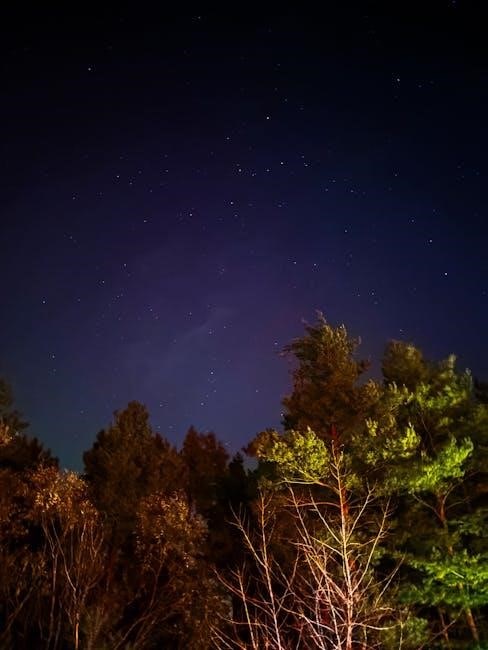
Allow your eyes to adjust to the darkness for at least 20-30 minutes to maximize your night vision; avoid looking at white lights during this time. If you must use a flashlight, use one with a red filter, as red light preserves your dark adaptation better than white light. Remember, preserving your eyesight is crucial for enjoying the beauty of the night sky for years to come!
Dealing with Light Pollution
Light pollution significantly hinders stargazing, washing out fainter celestial objects. Seek observing locations away from city lights – even a short drive can make a huge difference. Utilize light pollution maps (available online) to identify darker skies in your area.
At home, minimize outdoor lighting, shield existing lights to direct them downwards, and encourage neighbors to do the same. Allow your eyes at least 20 minutes to fully adapt to the darkness. Consider using a red-light flashlight to preserve your night vision while navigating. Reducing light pollution benefits both astronomy and the environment!
Appropriate Clothing and Supplies
Stargazing often involves extended periods outdoors, even in seemingly mild weather. Dress in layers to adapt to changing temperatures – it gets colder as the night progresses! Warm hats, gloves, and comfortable, waterproof footwear are essential.
Bring blankets or folding chairs for comfortable viewing. Insect repellent is crucial, especially during warmer months. A red-light flashlight preserves night vision. Snacks and drinks keep everyone energized and happy. Don’t forget a first-aid kit for minor scrapes or bumps, ensuring a safe and enjoyable experience for the whole family.
Resources for Further Learning
Descriptions and colorful diagrams introduce astronomy to beginners of all ages. Beyond this, consider supplemental books focusing on specific areas like constellations or planets to tailor learning to your family’s interests. These resources offer a fantastic foundation for understanding the universe and fostering a lifelong love of stargazing.
Online Astronomy Resources
Expand your knowledge with digital tools! The Amazon Book Review frequently features astronomy-related content, including book recommendations and author interviews, offering valuable insights. Numerous websites provide interactive star charts, real-time sky views, and educational articles.
Explore NASA’s website for stunning images, mission updates, and educational resources suitable for all ages. Websites dedicated to amateur astronomy often host forums and observing guides. These online platforms provide a dynamic and accessible way to learn about the universe and connect with fellow stargazers.
Local Astronomy Clubs and Events
Connect with a community of stargazers! Joining a local astronomy club offers fantastic opportunities for learning and observing. Clubs often host public star parties, providing access to telescopes and expert guidance. These events are perfect for families, allowing you to share the wonder of the night sky with others.
Check local listings and astronomy club websites for workshops, lectures, and observing sessions. Many clubs cater to beginners, offering a supportive environment to develop your astronomical skills. Participating in local events enhances your understanding and appreciation of the cosmos.