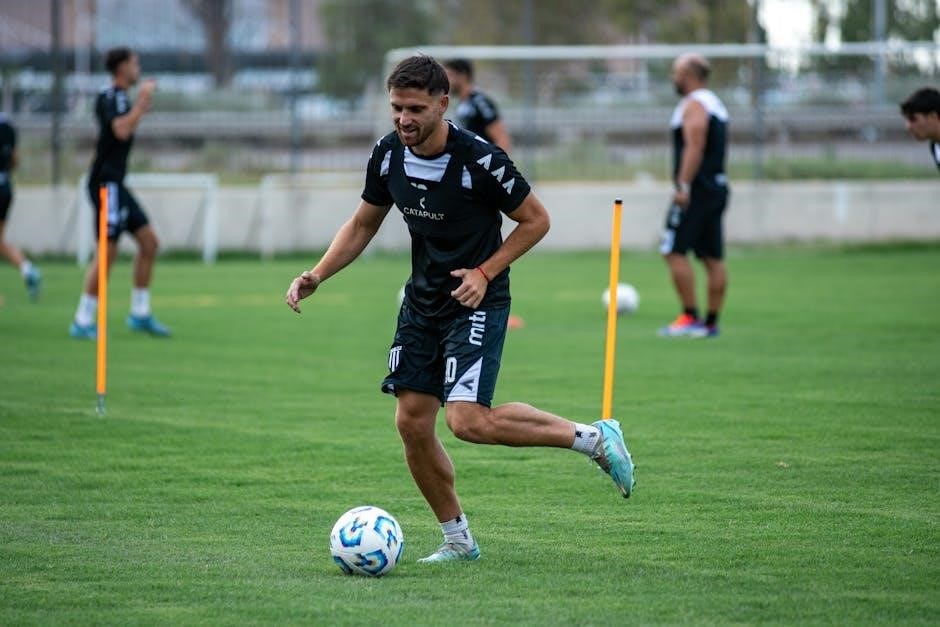
Soccer Training Drills PDF: A Comprehensive Plan
Today’s soccer landscape demands accessible, well-structured training resources.
A comprehensive PDF provides coaches and players with organized drills,
covering skills, tactics, and fitness – essential for development and success
on the field, mirroring the intensity of leagues like the Premier League.
These PDFs often include schedules, diagrams, and detailed instructions,
facilitating effective practice sessions. Accessing live scores and schedules
from sources like ESPN and Flashscore complements training with real-world
context, enhancing player understanding and competitive edge.
Furthermore, a good PDF will cater to various levels, from youth to
professional, ensuring appropriate challenges and progression, mirroring
the global reach of competitions like the Champions League and World Cup.
Soccer training drills, readily available in PDF format, represent a cornerstone of player development, bridging the gap between theoretical knowledge and practical application on the pitch. These resources are invaluable for coaches at all levels, from grassroots programs to professional academies, offering structured sessions designed to enhance individual skills and team cohesion.
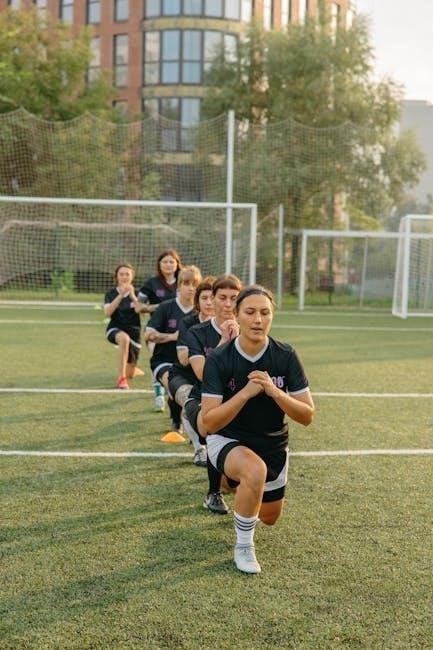
The proliferation of online platforms like ESPN and Soccerway, providing live scores and league standings, underscores the competitive nature of the sport. Consequently, effective training becomes paramount. PDF drill collections offer a systematic approach, encompassing fundamental techniques – dribbling, passing, shooting – alongside tactical maneuvers and physical conditioning.

A well-designed PDF isn’t merely a list of exercises; it’s a comprehensive plan. It details drill setups, coaching points, progressions, and regressions, allowing for adaptation to varying skill levels and player needs. Resources referencing major leagues like LaLiga, Serie A, and the Bundesliga demonstrate the global standards these drills aim to achieve. The accessibility of these PDFs empowers coaches to consistently deliver high-quality training, fostering a culture of improvement and maximizing player potential.
Ultimately, utilizing these resources helps prepare players for the demands of modern soccer, mirroring the intensity and tactical complexity seen in competitions like the World Cup.
II. Importance of a Structured Training Plan
A structured training plan, often delivered via a soccer training drills PDF, is fundamental to player improvement and team success. Random drills, while occasionally beneficial, lack the progressive overload necessary for sustained development. A well-defined plan ensures all essential components – technical skills, tactical awareness, physical conditioning, and mental fortitude – are addressed systematically.
Considering the competitive landscape highlighted by sites like Flashscore.com and ESPN, where teams vie for supremacy in leagues like the Premier League and Champions League, a haphazard approach is insufficient. A PDF-based plan provides a roadmap, outlining session objectives, drill sequences, and intensity levels.
This structure allows coaches to track player progress, identify weaknesses, and tailor training accordingly. The detailed nature of a PDF – including diagrams and coaching cues – minimizes ambiguity and maximizes efficiency. Furthermore, a consistent plan fosters a positive training environment, building player confidence and motivation.
Without structure, training becomes reactive rather than proactive, hindering long-term growth. Utilizing a PDF ensures a deliberate, focused approach, ultimately enhancing performance and preparing players for the challenges of competitive soccer, mirroring the preparation seen in major tournaments like the World Cup.
III. Essential Components of a Soccer Training Drill PDF
A comprehensive soccer training drills PDF must incorporate several key elements for effective implementation. Firstly, clear and concise drill descriptions are crucial, often including diagrams sourced from resources mirroring the tactical breakdowns found on sites like the Guardian’s football section; Secondly, each drill should specify required equipment – cones, balls, goals – ensuring coaches are prepared.
Furthermore, a PDF should detail the drill’s objectives: what specific skill or tactic is being developed? Intensity levels, age appropriateness, and modifications for varying skill levels are also vital. Considering the diverse leagues covered by ESPN and Flashscore, adaptability is key.
A well-structured PDF will categorize drills – warm-ups, skill work, tactical exercises, and cool-downs – creating a logical training flow. It should also include progressions, allowing coaches to increase difficulty as players improve. Safety guidelines are paramount, protecting players during intense sessions.
Finally, a useful PDF might offer coaching points, emphasizing proper technique and common errors to avoid, ultimately maximizing the effectiveness of each drill and preparing players for competition, as seen in major events like the World Cup.
III.A. Warm-up Exercises
Effective warm-up exercises within a soccer training drill PDF are paramount for injury prevention and performance enhancement. These should begin with light cardiovascular activity – jogging, jumping jacks – gradually increasing heart rate and blood flow, preparing muscles for more strenuous work. Dynamic stretching is crucial, incorporating movements like leg swings, arm circles, and torso twists.
A PDF should detail specific warm-up routines, potentially including cone drills for agility and quick feet, mirroring the speed and agility demands highlighted in live soccer coverage on ESPN. Small-sided rondos, focusing on passing and receiving, also serve as excellent dynamic warm-ups, enhancing technical skills.
Furthermore, warm-ups should progressively introduce soccer-specific movements – short sprints, cutting drills, and ball manipulation exercises. These prepare players for the demands of the training session, reducing the risk of muscle strains and improving overall performance, similar to the preparation seen in professional leagues like LaLiga.
A well-designed PDF will emphasize the importance of proper technique during warm-ups, ensuring players execute movements correctly and safely, maximizing benefits and minimizing injury risk.
IV. Skill-Specific Drills
Skill-specific drills, detailed within a soccer training drill PDF, form the core of player development. These drills isolate and refine fundamental techniques, building a strong foundation for tactical understanding and game performance. A comprehensive PDF will categorize drills by skill – dribbling, passing, shooting, receiving – offering progressive exercises for varying skill levels.
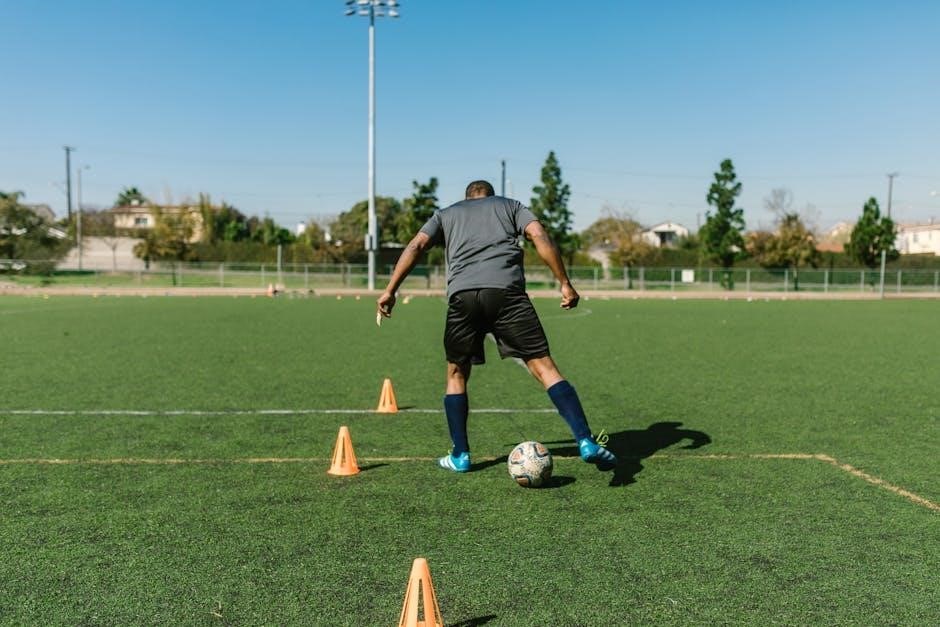
Dribbling drills might include cone weaving, slalom courses, and one-on-one challenges, enhancing ball control and agility. Passing drills focus on accuracy, weight, and technique, utilizing short and long passing variations. Shooting drills emphasize power, placement, and finishing, incorporating different shooting techniques.
A quality PDF will provide clear diagrams and instructions for each drill, alongside coaching points to emphasize proper technique. These drills should mimic game-like scenarios, preparing players for the demands of competition, as seen in leagues like the Bundesliga and Serie A.
Furthermore, the PDF should suggest drill progressions, allowing coaches to challenge players as their skills improve, fostering continuous development and maximizing training effectiveness.
IV.A. Dribbling Drills
Dribbling drills, as outlined in a soccer training drill PDF, are crucial for developing a player’s close control, agility, and ability to beat opponents. A well-structured PDF will offer a variety of drills, progressing from basic ball mastery to more complex game-realistic scenarios.
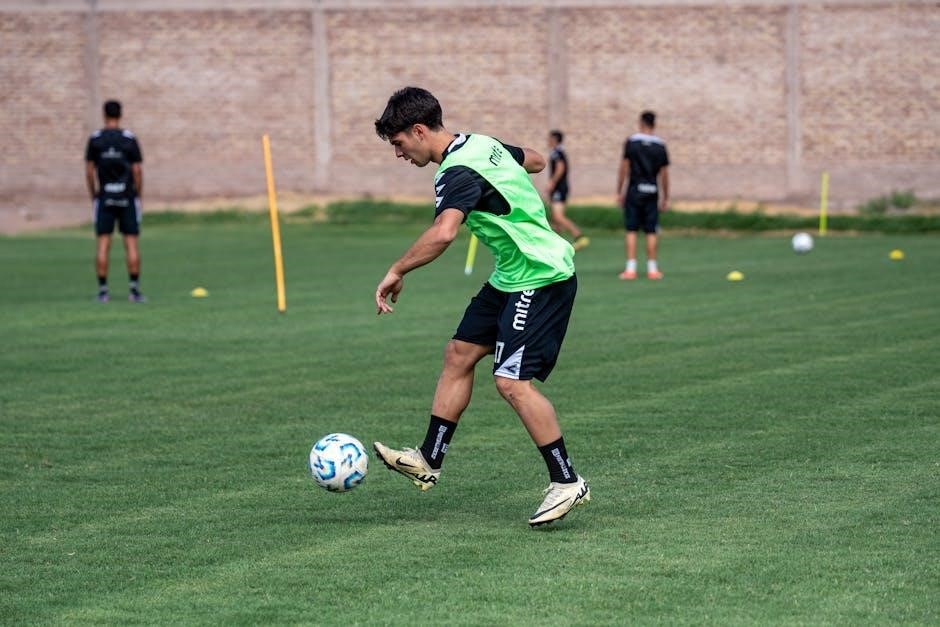
Cone weaving drills are fundamental, improving a player’s ability to change direction quickly and maintain close control at speed; Slalom courses further challenge agility and coordination. More advanced drills include one-on-one dribbling against a defender, focusing on feints, changes of pace, and protecting the ball.
The PDF should detail drill setups, including cone placement and distances, as well as coaching points emphasizing proper technique – keeping the ball close, using both feet, and maintaining a low center of gravity. Drills should simulate the pressure of a game, mirroring the dynamic movements seen in leagues like LaLiga.
Progressions might involve adding defenders, limiting touches, or incorporating specific objectives, like dribbling to a designated target. These drills build confidence and creativity on the ball.
IV.B. Passing Drills
Passing drills, detailed within a comprehensive soccer training drill PDF, are foundational for building team cohesion and effective ball movement. These drills focus on accuracy, weight of pass, and receiving technique – skills vital for success in leagues like the Bundesliga and Serie A.
Short passing drills, often conducted in a grid, emphasize quick, accurate passes with minimal space, improving players’ ability to maintain possession. Long passing drills develop the ability to switch play and deliver accurate balls over distance, simulating game scenarios.
A quality PDF will include variations like passing triangles and squares, promoting movement and creating passing options. Coaching points should highlight proper foot placement, body positioning, and communication. Drills should progress from stationary passing to passing on the move.
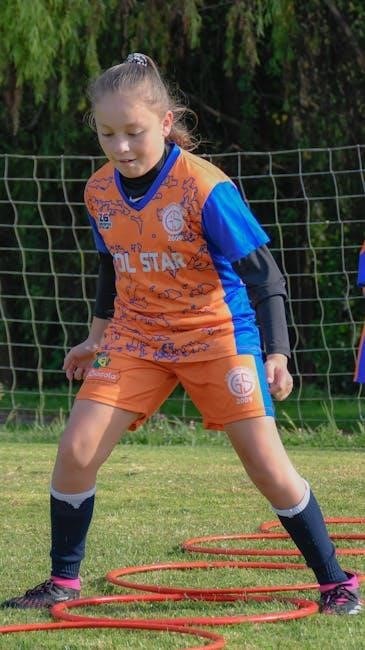
More advanced drills incorporate defenders, requiring players to make quick decisions and execute passes under pressure. These drills build a player’s vision and understanding of spatial awareness, mirroring the tactical complexity of the Champions League.
IV.C. Shooting Drills
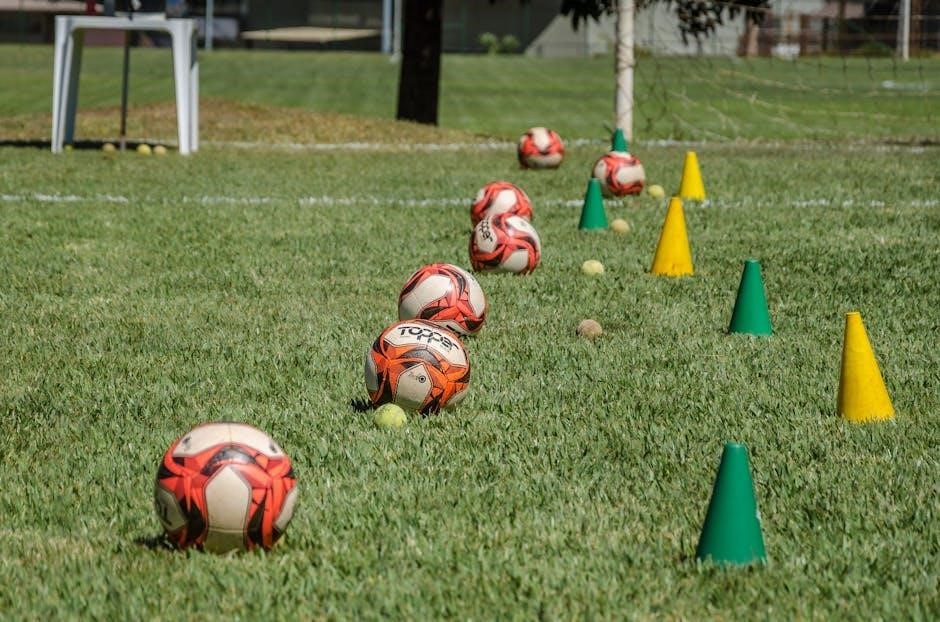
Shooting drills, a crucial component of any soccer training drill PDF, aim to improve a player’s technique, power, and accuracy in front of goal – skills essential for competing in leagues like LaLiga and the MLS. A well-structured PDF will offer a progression of drills, starting with fundamental techniques.
Stationary shooting drills focus on proper foot placement, body positioning, and follow-through. Players practice striking the ball with different parts of their foot, developing versatility. Dribbling into shooting drills combine ball control with finishing, simulating game-like situations.
More advanced drills incorporate passing combinations leading to a shot, emphasizing quick decision-making and timing. Shooting under pressure, with defenders present, replicates the challenges faced during matches, mirroring the intensity of the Premier League.
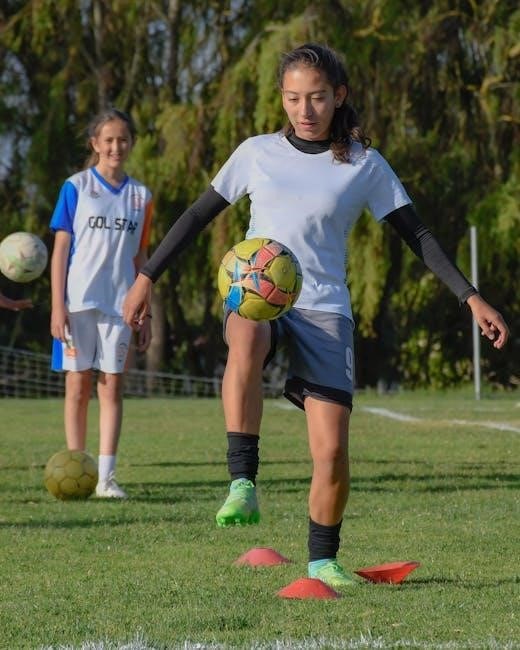
A comprehensive PDF will detail coaching points on striking the ball cleanly, generating power, and aiming for specific targets. Tracking shot accuracy and power helps monitor player progress, enhancing their effectiveness in front of goal.
IV.D. Receiving & Control Drills
Receiving and control drills are foundational in any effective soccer training drill PDF, vital for players aiming to excel in leagues like Serie A and the Bundesliga. These drills focus on developing the ability to receive passes cleanly, control the ball effectively, and set up subsequent actions.
Basic receiving drills involve receiving passes with different body parts – foot, thigh, chest – emphasizing soft touches and proper cushioning. Turning drills challenge players to receive the ball and quickly turn to face a new direction, simulating game scenarios.
More advanced drills incorporate receiving under pressure, requiring players to control the ball while being challenged by a defender. First-touch passing drills emphasize receiving and immediately playing a pass, improving speed of play.
A quality PDF will detail coaching points on body positioning, anticipating the pass, and using appropriate surfaces for control. Tracking a player’s ability to consistently control the ball under pressure is key to monitoring progress and enhancing their overall game, mirroring the demands of top-tier soccer.
V. Tactical Drills
Tactical drills, crucial components within a comprehensive soccer training drill PDF, move beyond individual skills to emphasize team play and strategic understanding, mirroring the complexities of leagues like LaLiga and the Champions League. These drills aim to improve players’ decision-making, positioning, and coordination.
Positional play drills focus on maintaining shape, creating passing lanes, and exploiting space, essential for building attacks and defending effectively. Movement off the ball is a key element, teaching players to make intelligent runs and support teammates.
Small-sided games (SSGs) are highly effective for developing tactical awareness in a game-like environment. These scaled-down matches force players to make quick decisions and apply tactical principles under pressure.
A well-designed PDF will include diagrams illustrating formations and movement patterns. Analyzing game footage and discussing tactical concepts alongside practical drills enhances understanding. Tracking team performance in SSGs provides valuable insights into tactical effectiveness, preparing players for the demands of competitive soccer.
V.A. Positional Play Drills
Positional play drills, detailed within a soccer training drill PDF, are foundational for developing a team’s ability to maintain structure and control possession, mirroring the tactical sophistication seen in leagues like Serie A and the Bundesliga. These drills emphasize player roles and responsibilities within a defined formation.
Key exercises involve players maintaining specific zones, practicing passing combinations to progress the ball, and understanding when to move and support teammates. Triangle passing drills are common, fostering quick circulation and creating passing options.
A PDF should illustrate diagrams showing player positioning and movement patterns. Drills can be progressed by adding defenders or limiting touches, increasing the challenge. Coaches should emphasize the importance of communication and scanning the field.
Effective positional play requires players to understand spatial awareness and anticipate opponents’ movements. Regularly assessing players’ ability to maintain shape and execute passing combinations is crucial for improvement, preparing them for the tactical demands of high-level competition.
V.B. Small-Sided Games (SSG)
Small-Sided Games (SSGs), a cornerstone of modern soccer training, are extensively detailed in comprehensive drill PDFs. These games, played with fewer players on reduced field sizes, maximize touches, decision-making, and tactical awareness – mirroring the fast-paced nature of leagues like LaLiga and the MLS.
Common SSG formats include 3v3, 4v4, and 5v5, with variations in goals (e.g., target goals, regular goals) and rules (e.g., limited touches, mandatory passes); A quality PDF will provide diagrams illustrating setup and potential variations.
SSGs are invaluable for developing transition play, as players constantly switch between attack and defense. They also enhance problem-solving skills and creativity under pressure. Coaches should focus on observing player positioning, movement off the ball, and communication.
Progressions can involve reducing field size, increasing the number of defenders, or adding specific objectives. SSGs effectively bridge the gap between isolated drills and full-sided matches, preparing players for real-game scenarios.
V.C. Transition Drills (Attack to Defense & Vice Versa)
Transition drills, crucial for replicating game realities, are a prominent feature within soccer training drill PDFs. These exercises focus on the swift shift from attacking to defending, and vice versa – a key determinant of success in leagues like the Bundesliga and Serie A. Effective PDFs detail drills emphasizing speed of thought and execution.
Typical drills involve initiating an attack, then immediately losing possession, requiring players to react and reorganize defensively. Conversely, winning possession necessitates a rapid counter-attack. Key coaching points include immediate pressure on the ball, quick recovery runs, and supporting angles.
PDFs often include variations like 3v2 to 2v3 transitions, or full-field scenarios starting with a goalkeeper distribution. These drills demand communication, awareness, and decision-making under pressure. Observing player reactions to turnovers is vital.
Progressions involve reducing reaction time or increasing the number of players involved. Mastering transitions separates good teams from great ones, mirroring the dynamic play seen in top competitions like the Champions League.
VI. Fitness & Conditioning Drills
Soccer training drill PDFs consistently dedicate significant sections to fitness and conditioning, recognizing the sport’s demanding physical requirements. These drills aim to build endurance, speed, and agility – essential for competing in leagues like LaLiga and the MLS. A well-structured PDF will categorize drills for targeted improvement.
Endurance drills often involve continuous running with changes in pace, simulating the sustained effort required during a match. Speed drills focus on short, explosive bursts, improving acceleration and maximum velocity. Agility drills utilize cones and markers to enhance quickness and change of direction.
PDFs frequently include interval training, shuttle runs, and plyometrics to develop both aerobic and anaerobic capacity. Proper warm-up and cool-down routines are also emphasized, minimizing injury risk. Monitoring player heart rates and perceived exertion levels is crucial.
Integrating fitness drills with technical work maximizes efficiency. A physically prepared team is better equipped to execute tactical plans and maintain intensity throughout a 90-minute game, mirroring the demands of the World Cup.
VI.A. Agility Drills
Soccer training drill PDFs highlight agility drills as crucial for developing quick reactions, change of direction speed, and overall maneuverability on the field. These drills are fundamental for players aiming to excel in fast-paced leagues like the Bundesliga and Serie A.
Common agility drills include cone drills – weaving through cones at varying speeds and distances – ladder drills – focusing on footwork and coordination – and shuttle runs – emphasizing rapid acceleration and deceleration. PDFs often provide diagrams illustrating drill setups and execution techniques.
Reactive agility drills are also frequently included, challenging players to respond to visual or auditory cues, simulating game-like scenarios. These drills improve decision-making speed and the ability to react to opponents’ movements.
Progressive overload is a key principle, gradually increasing the difficulty and intensity of drills. Proper technique and form are emphasized to prevent injuries. Integrating agility drills into warm-ups prepares players for the demands of training and matches, mirroring the dynamic play seen in the Champions League.
VI.B. Speed Drills
Soccer training drill PDFs consistently emphasize speed drills as vital for gaining a competitive edge, particularly in leagues renowned for their pace, such as the Premier League and LaLiga. These drills focus on improving linear speed, acceleration, and explosive power.
Sprints are a cornerstone, ranging from short bursts (10-20 meters) to longer sprints (40-60 meters), often incorporating starting techniques and acceleration phases. Flying sprints, where players reach top speed before entering a timed zone, are also common.
Overspeed training, utilizing resistance bands or downhill runs, can further enhance speed potential. Reaction speed drills combine speed with cognitive processing, requiring players to react quickly to a stimulus while sprinting.
PDF resources often detail proper running mechanics, emphasizing efficient stride length and arm action. Interval training, alternating between high-intensity sprints and recovery periods, builds both speed and endurance. Consistent implementation, mirroring the demands of the World Cup, is key to improvement.
VI.C. Endurance Drills
Soccer training drill PDFs universally recognize endurance as a foundational element, crucial for sustaining performance throughout a 90-minute match, mirroring the demands of top leagues like Serie A and the Bundesliga. These drills aim to improve both aerobic and anaerobic capacity.
Continuous running, at a moderate intensity, builds a base level of aerobic fitness. Interval runs, alternating between high-intensity bursts and recovery periods, enhance anaerobic endurance and the ability to recover quickly.
Shuttle runs, covering varying distances with quick changes of direction, simulate the dynamic movements of a game. Long-distance runs, while less frequent, contribute to overall stamina and recovery capacity.
PDF resources often incorporate circuit training, combining endurance exercises with strength and agility work. Fartlek training, varying pace and intensity spontaneously, mimics the unpredictable nature of a match. Consistent endurance work, vital for competitions like the Champions League, prevents fatigue and maintains performance levels.
VII. Goalkeeper Specific Drills
Soccer training drill PDFs dedicated to goalkeeping emphasize specialized techniques distinct from outfield player training. These drills focus on reaction time, agility, shot-stopping, distribution, and command of the penalty area – skills vital for success, mirroring the demands of professional leagues.
Shot-stopping drills involve reacting to various shot types (grounded, aerial, deflections) from different angles and distances. Footwork drills improve agility and positioning. Handling drills focus on secure catching and control.
Distribution drills practice throwing and kicking accurately to teammates, initiating counter-attacks. Cross-handling drills simulate game scenarios, requiring quick decisions and assertive claiming of crosses.
PDF resources often include reaction drills using tennis balls or other small objects to enhance reflexes. 1v1 drills simulate game pressure, forcing goalkeepers to make quick decisions. Consistent, focused training, crucial for tournaments like the World Cup, builds confidence and improves performance under pressure.
VII.A. Shot Stopping Drills
Shot-stopping drills, detailed in many soccer training drill PDFs, are foundational for goalkeeper development. These drills progressively challenge reflexes, technique, and decision-making under pressure, mirroring the fast-paced action of leagues like the Premier League and Serie A.
Basic drills involve a coach shooting from close range, focusing on proper hand position (W-shape), footwork, and diving technique. Progressive drills increase distance, shot power, and introduce angled shots, demanding quicker reactions.
Reaction drills utilize quick, unexpected shots to test reflexes. Deflection drills simulate game scenarios where the ball changes direction, requiring adjustments. High ball drills focus on claiming crosses and aerial balls securely.
Advanced PDFs incorporate game-realistic scenarios, including 1v1s and shots following passes. Consistent practice, as highlighted by resources like ESPN, builds confidence and improves the goalkeeper’s ability to make crucial saves, vital for success in competitions like the Champions League.
VII.B. Distribution Drills
Distribution drills, commonly found in soccer training drill PDFs, are crucial for modern goalkeepers, evolving beyond simply clearing the ball. Effective distribution initiates attacks and maintains possession, mirroring tactical approaches in leagues like LaLiga and the Bundesliga.
Basic drills focus on accurate throwing technique – overarm, sidearm, and rolling throws – targeting specific teammates. Short passing drills emphasize quick, precise distribution to defenders, building play from the back.
Long kicking drills develop range and accuracy, aiming for target zones or initiating counter-attacks. Pressure drills simulate game scenarios, requiring quick decisions under duress, as seen in live scores from Flashscore.
Advanced PDFs incorporate patterns of play, demanding goalkeepers distribute to specific areas to create attacking opportunities. Consistent practice, highlighted by resources like ESPN, enhances a goalkeeper’s ability to contribute to the team’s overall build-up play, becoming a vital asset in possession-based systems.
VIII. Cool-Down and Recovery
Cool-down and recovery sections within soccer training drill PDFs are often overlooked, yet are paramount for injury prevention and optimal performance, mirroring the dedication required in leagues like the Premier League and Serie A. A proper cool-down gradually lowers heart rate and reduces muscle soreness.
Static stretching, holding each stretch for 20-30 seconds, improves flexibility and range of motion. Light jogging aids in lactic acid removal, preventing stiffness, as reported in soccer news from FOXSports.com.
Foam rolling targets muscle knots and improves blood flow, accelerating recovery. Hydration is crucial, replenishing fluids lost during training, vital for maintaining peak condition.
PDFs may include specific recovery protocols, like ice baths or compression garments, enhancing muscle repair. Prioritizing cool-down and recovery, alongside utilizing resources like ESPN for scheduling, ensures players remain healthy and prepared for subsequent training sessions and matches, maximizing their potential.
IX. Utilizing PDF Formats for Training Drills
PDFs offer a versatile and accessible format for soccer training drills, enabling easy distribution and storage for coaches and players alike. Their portability allows for on-field access during sessions, mirroring the real-time updates available on sites like Flashscore.com.
PDFs can incorporate diagrams, illustrations, and detailed instructions, clarifying drill setups and execution. They support multimedia embedding, linking to videos demonstrating proper technique, enhancing understanding, similar to highlights found on ESPN.
Interactive PDFs allow for annotation and customization, enabling coaches to tailor drills to specific team needs. Search functionality quickly locates desired drills within a larger collection, streamlining session planning.
Furthermore, PDFs are easily shareable via email or cloud storage, facilitating collaboration among coaching staff. Utilizing this format ensures consistent delivery of training content, promoting player development and mirroring the structured approach of professional leagues like LaLiga, as reported in soccer news from the Guardian.
X. Resources for Finding Soccer Training Drills PDFs
Numerous online platforms offer a wealth of soccer training drills PDFs, catering to diverse skill levels and coaching philosophies. Websites dedicated to soccer coaching, like those providing live scores and schedules on Soccerway, frequently host downloadable resources.
Soccer-specific forums and communities often share PDFs created by experienced coaches, fostering a collaborative learning environment. Professional soccer organizations, such as national governing bodies, may provide free or premium drill collections.
Online marketplaces, like Etsy or specialized coaching sites, sell comprehensive PDF packages covering various aspects of the game, mirroring the in-depth coverage found on FOXSports.com. YouTube channels dedicated to soccer coaching often link to accompanying PDF resources in their video descriptions.
Remember to evaluate the source’s credibility and the drill’s suitability for your team’s age and ability. Utilizing resources like ESPN for league insights can inform drill selection, ensuring relevance and effectiveness, similar to tracking player progress.
XI. Adapting Drills for Different Age Groups
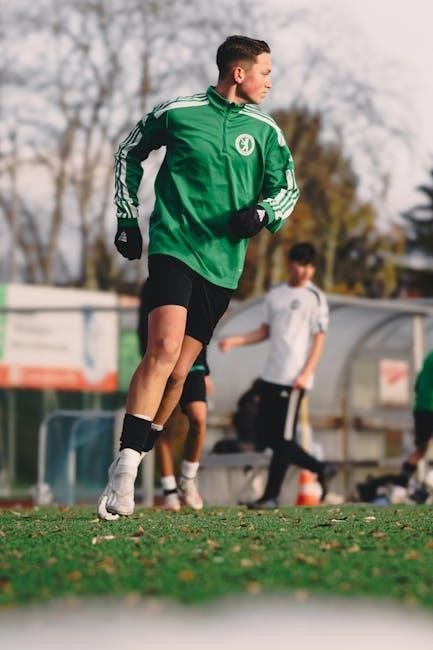
Effective soccer training necessitates adapting drills to suit varying age groups and developmental stages. Younger players (U6-U10) benefit from simplified drills focusing on fundamental skills like dribbling and passing, using smaller fields and fewer players.
Intermediate players (U11-U14) can handle more complex drills incorporating tactical elements and increased physical demands, building upon foundational skills. Older players (U15+) require drills that emphasize game-specific scenarios, strategic positioning, and advanced techniques.
Modifications include adjusting field size, ball count, player numbers, and the complexity of rules. Focus on fun and engagement for younger players, while emphasizing technical precision and tactical understanding for older groups.
Consider physical maturity when designing drills, avoiding excessive fatigue or risk of injury. Resources offering live scores, like Flashscore, can inspire realistic game scenarios for older players, while ensuring drills remain age-appropriate and promote long-term development.
XII. Safety Considerations in Soccer Training
Prioritizing player safety is paramount in all soccer training drills. A comprehensive PDF should explicitly address potential hazards and preventative measures. Proper warm-up and cool-down routines are crucial to minimize muscle strains and injuries, preparing the body for exertion and aiding recovery.
Ensure adequate hydration and appropriate clothing for weather conditions. Regularly inspect the playing surface for obstacles and hazards, maintaining a safe training environment. Teach proper technique to reduce the risk of collisions and overuse injuries.
First aid knowledge and access to emergency medical care are essential. Supervise drills closely, intervening when necessary to correct unsafe practices. Modify drills based on player fitness levels and any pre-existing conditions.
Awareness of concussion protocols and immediate removal from play for suspected head injuries is vital, mirroring the seriousness of professional leagues tracked by ESPN. A well-designed PDF will emphasize these safety guidelines, fostering a culture of responsible training.
XIII. Tracking Player Progress & Drill Effectiveness
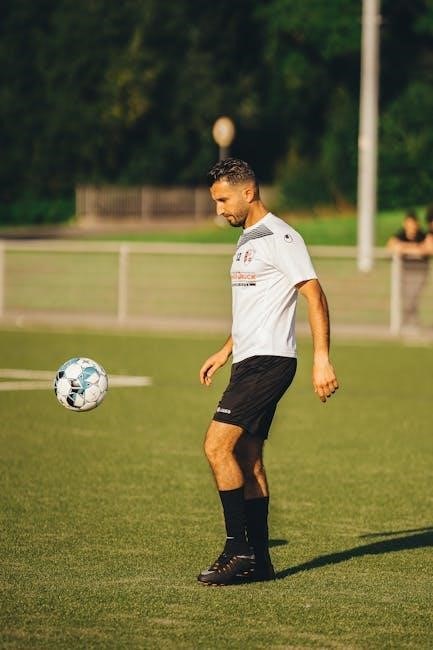
A valuable soccer training drills PDF extends beyond simply listing exercises; it incorporates methods for monitoring player development. Regular assessments – observing technique, speed, and tactical understanding – provide quantifiable data. Tracking key performance indicators (KPIs), like pass completion rates or shooting accuracy, reveals drill effectiveness.
Utilize simple recording sheets within the PDF to document individual and team progress. Compare results over time to identify areas of improvement and plateaus. Adjust drills based on these findings, optimizing the training plan for maximum impact, similar to how professional teams analyze match data from sources like Flashscore.
Consider subjective feedback from players regarding drill difficulty and enjoyment. Video analysis can offer detailed insights into technique and movement patterns. A well-structured PDF facilitates a data-driven approach to coaching, ensuring training remains relevant and productive.
Consistent monitoring allows for personalized training adjustments.